Author: sitenova_admin

  • Whole-House Surge Protection: What It Covers and What It Does Not

    Storm damage to electronics rarely happens while the power is out. It happens in the second the power comes back. Ready.gov puts it plainly in its guidance on power outages: power may return with momentary surges or spikes that can cause damage, which is why it advises turning off or disconnecting appliances, equipment and electronics during an outage.

    That advice works, and it depends on somebody being home to follow it. Panel-level surge protection is the version that does not. Here is what it addresses, what it leaves alone, and the questions worth asking before anyone installs one.

    Most surges do not come from the sky

    The mental image is a lightning strike. The arithmetic says otherwise. The Electrical Safety Foundation International, citing the National Electrical Manufacturers Association in its guide to outlet types, notes that 60 to 80 percent of surges are created within the building, such as when large appliances like air conditioners turn on and off.

    That reframes the problem. A house with a heat pump, a well pump, a compressor and a dryer generates its own small events all year. External events from utility switching or weather sit on top of that. Protection that only makes sense during storm season is protection sized for the smaller half of the problem.

    The two layers, and why one does not replace the other

    Surge protection is normally discussed as layers rather than as a single product.

    • At the service panel. A surge protective device installed at the panel is intended to reduce what gets past the service and out into the branch circuits. It covers hardwired equipment that has no plug to protect, which is the part homeowners forget: the heat pump, the range, the well pump, the door opener, the alarm.
    • At the point of use. ESFI describes the surge suppression receptacle as protecting sensitive electronic equipment from transient surges, notes it is not required by the National Electrical Code, and observes it is often installed in rooms containing costly devices such as computers, televisions or refrigerators. Plug-in strips occupy the same role.

    The reason both exist is that they sit at different points on the path. A device at the panel does not sit between your desk outlet and your computer, and a strip behind the television does nothing for the air handler in the attic. Anyone weighing this should ask a provider what the panel device is rated to handle, what it protects, and what it does not.

    Where code sits on this

    Surge protection has moved from optional to expected in newer construction. ESFI’s surge protection resource tracks the change: in 2017 the National Electrical Code required surge protective devices for equipment such as emergency elevators and fire pump controllers; in 2020 residences were required to have surge protection to safeguard large appliances and equipment such as HVAC systems, as well as life-safety equipment like smoke alarms; and in 2023 dormitories, hotel rooms and bedrooms in nursing homes and limited care facilities were added.

    What applies to your house is a separate question. ESFI explains on its National Electrical Code page that the NEC codifies minimum requirements, that it is not itself a law but is commonly mandated by state or city law, and that a new edition is produced every three years. So which edition governs work at your address depends on what your jurisdiction has adopted, which is a question for your building department and for whoever performs the work.

    What a panel device will not do for you

    Four honest limits, because this is a product that gets oversold.

    1. It does not keep the lights on. Surge protection and backup power are different subjects with different hardware. If continuity is the actual goal, that conversation is the one about whole-home generator requests, and the tradeoffs are laid out in the comparison of standby and portable generators.
    2. It does not repair the system it sits in. A surge device works against the grounding system it is connected to, and ESFI describes grounding as the path that carries extra current to earth in the event of a short circuit or overload. On a system with grounding problems, that question comes first.
    3. It is not a lightning protection system. Those are separate installations with a separate purpose, and no panel device should be sold as one.
    4. It does not cover every conductor entering the house. Ask specifically what the proposal addresses and what it leaves out, rather than assuming the answer is everything.

    Reading the aftermath of a storm

    Homeowners often suspect a surge without being sure. A few observations are worth writing down while they are fresh, because they shape what anyone looking at the system will want to check.

    • What failed, and what survived. A single dead device points somewhere different from several failures spread across rooms.
    • Whether the failures share a circuit. Clocks that reset everywhere say one thing; three items on one wall say another.
    • Whether protective devices tripped, and which ones. A breaker, a ground fault device and an arc fault device each tell a different story.
    • Whether anything smells hot, looks discolored or is warm to the touch. That moves the situation out of the electronics category entirely and into a repair conversation.
    • The sequence: did the equipment fail during the outage, or when power came back? Ready.gov’s warning about spikes on restoration makes the second case common.

    Practical questions before installation

    • Does the panel have physical space for the device, and if not, what changes? That answer usually turns the job into a panel-related request.
    • Does the device have a status indicator, and how would you know it had reached the end of its useful life?
    • Is it replaceable on its own, or does replacement mean more work?
    • What does the manufacturer’s documentation say about the conditions it is rated for?
    • Will the work be permitted and inspected, and who handles that?
    • Ask the provider to confirm their licensing and insurance before scheduling. Reasonable question, easy answer.

    What to do during an outage regardless

    Hardware does not replace behavior. Ready.gov’s power outage guidance is worth following whether or not a panel device is installed.

    • Disconnect appliances and electronics to avoid damage from electrical surges, since power may return with momentary surges or spikes.
    • Keep freezers and refrigerators closed. Ready.gov states a refrigerator will keep food cold for about four hours and a full freezer will hold its temperature for about 48 hours.
    • Use a generator outdoors only, at least 20 feet away from windows, doors and attached garages, and never use a gas stove or oven to heat the home.
    • Install working carbon monoxide detectors on every level of the home.
    • Take an inventory of what you rely on that needs electricity, and plan alternatives for medical devices and refrigerated medicines.

    Common questions

    Do I still need power strips if there is a device at the panel?

    The two layers do different jobs at different points. A panel device does not sit between a wall outlet and the equipment plugged into it, which is the gap point-of-use protection is designed for.

    Does a generator make surge protection unnecessary?

    No. A generator addresses the absence of power. Surge protection addresses the quality of it, including the surges ESFI attributes to equipment cycling inside the building. Households often end up looking at both, along with the condition of the existing service.

    How long does a surge device last?

    That depends on the product and what it has absorbed, which is why the indicator question matters and why the documentation is worth reading before you buy rather than after. Ask the provider how you are supposed to know when it needs replacing.

    My electronics already failed. Is it too late?

    For the equipment, probably. For the house, no, and if a surge event damaged wiring or devices, that is separate from the protection question and belongs in a repair request.

    Checking what is available near you

    This site is a connection service. It does not perform electrical work and has no technicians. It routes requests toward participating providers through service-area matching.

    If you want to find out what is available at your address, call (844) 334-2333 and describe your panel and what you want protected. Availability varies. If a participating provider can assist, they may contact you directly, and you decide whether to move forward.
  • GFCI and AFCI Protection: What Each Does When It Trips

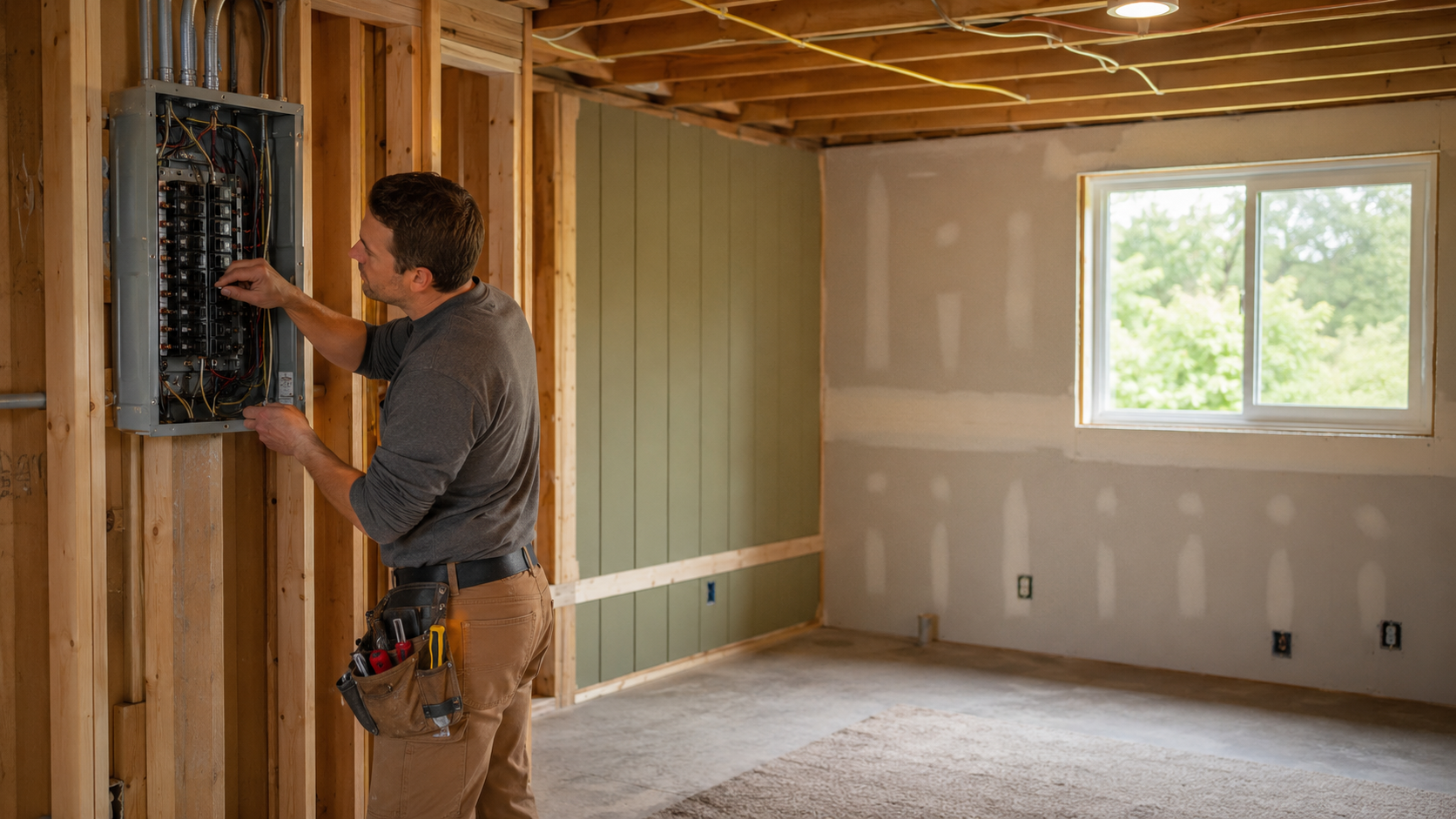
    Two devices in a modern house exist to interrupt power before something bad finishes happening. They get talked about as if they were the same product with different letters. They are not. One watches for current going somewhere it should not. The other listens for a particular kind of electrical noise. Knowing which one just cut power to your bathroom, and why, changes what you do next.

    GFCI: the one that watches current leave

    A ground fault circuit interrupter compares what goes out against what comes back. The Electrical Safety Foundation International describes the device in its guide to the home electrical system as tripping when it detects ground faults or leakage current, cutting power if the electricity flowing into the circuit differs by even a slight amount from what is returning. Its outlet reference adds the speed: within as little as one fortieth of a second.

    The reason that matters is the scenario it is built for, which is a person becoming part of the leakage path. ESFI notes that since the 1970s, GFCIs have helped cut the number of home electrocutions in half.

    Where they belong follows water. ESFI places them in bathrooms, garages, kitchens, laundry areas and outdoors, and notes that the 2008 edition of the National Electrical Code requires them in kitchens, bathrooms, garages and outdoors.

    AFCI: the one that listens for arcing

    An arc fault is a different animal. ESFI describes it as a dangerous electrical problem caused by damaged, overheated or stressed wiring or devices, and makes the point that without an arc fault circuit interrupter, arc faults may stay hidden from view until it is too late. The device replaces a standard breaker in the panel and interrupts power when it recognizes the signature of arcing.

    The scale is the argument. ESFI’s AFCI resource states that arcing faults are responsible for starting more than 30,000 home fires each year in the United States. Its outlet reference cites a CPSC estimate that more than half of the electrical fires occurring every year could be prevented by AFCIs. ESFI also notes that the U.S. Department of Housing and Urban Development’s Healthy Homes Report listed the absence of AFCIs among the primary residential hazards associated with burns and fire-related injuries, and that the National Electrical Code has required AFCI protection for almost every circuit in the home since 2008.

    In short: the GFCI is there for the person, the AFCI is there for the house.

    What neither device does

    Both are narrow instruments, and expecting more from them is how households end up under-protected.

    • Neither one is an overload device. ESFI describes the fuses and breakers in the service panel as what protects the wires in each circuit from overheating by stopping current that exceeds the safe level. Ground fault and arc fault protection sit alongside that job, not in place of it.
    • Neither is a surge device. Transient surges are a separate category with separate hardware.
    • Neither replaces smoke alarms. ESFI frames arc fault protection as one component of a family fire safety plan, next to alarms and escape planning rather than instead of them.
    • Neither fixes the underlying condition. A device that keeps interrupting a circuit has done its job by telling you something. The circuit is still whatever it was.

    Why the reset button is in another room

    This is the practical part nobody explains until it happens. Both technologies come in two forms, and the form determines where you go when power disappears.

    • Breaker version. Lives in the panel and protects everything on the circuit. If the panel is where the protection sits, that is where the reset is.
    • Receptacle version. Lives in a box, protects itself and, in typical wiring, the receptacles fed downstream of it. A garage outlet can therefore control a patio outlet, and a single bathroom device can control the receptacle in a second bathroom.

    So when an outdoor receptacle goes dead after a rainstorm, the reset button is often indoors on a wall you have walked past a thousand times. Working out that map once, and writing it on the panel directory, saves the whole exercise next time. ESFI’s broader safety advice makes the same point about labeling breakers so you understand the circuits in your home.

    What a trip is actually telling you

    The phrase “nuisance tripping” is a description of how it feels, not a diagnosis. The device may be reporting something real. The useful move is to narrow it before calling anyone.

    1. Note whether it trips immediately or under load. Tripping the moment you reset it, with nothing connected, is a different story from tripping when the pressure washer starts.
    2. Unplug everything on the circuit, then reset. If it holds, add loads back one at a time. Old motors, heating elements and anything that has been damp are the usual suspects.
    3. Check whether weather correlates. Outdoor and garage circuits that trip only after rain point at moisture somewhere in the run, a fixture or a receptacle.
    4. Note if it started after work was done. A new fixture, a new appliance or a nail in a wall changes the timeline in a way that is worth reporting.
    5. Test the device itself. If the test button no longer trips it, the device is not protecting anything, whatever else is going on.

    Write those observations down. They are the difference between a repair request that starts with information and one that starts from scratch. If the tripping is at the panel rather than at a receptacle, and it involves more than one circuit, the conversation usually widens toward panel-related requests instead.

    Monthly testing takes a minute

    ESFI recommends testing GFCIs once a month to confirm they are working properly. The routine is short: press TEST, confirm power to the receptacle is cut, press RESET, confirm it comes back. A device that does not trip when tested, or does not reset afterwards, needs to be replaced rather than ignored.

    Add anything on a downstream receptacle to the same monthly check, because a device protecting three outlets is worth confirming across all three.

    When the tripping is really a wiring question

    Repeated trips on a circuit with nothing unusual plugged into it, trips that follow a room rather than a device, or protection that will not hold after a device has been replaced all point away from the appliance and toward the circuit. That is the point at which the subject becomes the conductors and connections themselves, which is where wiring and rewiring work enters the picture, and where an inspection request is often the sensible first step.

    The same logic applies in reverse when circuits are new. Anyone planning added living space, such as the circuits involved in an ADU conversion, should be asking which protection applies to which new circuit before the walls close, not after.

    Common questions

    Can I swap an AFCI breaker for a standard one to stop the tripping?

    No. That does not resolve anything; it removes the protection that was reporting the condition. If a device trips persistently, the thing to investigate is the circuit, not the breaker’s existence.

    Why does my bathroom outlet have no test button?

    Because the protection is probably somewhere else, either upstream at another receptacle or in the panel. Find the device that controls it, and note the relationship where you will find it again.

    An old appliance suddenly started tripping the GFCI. Why now?

    Insulation degrades, moisture accumulates, motors wear. A small leakage path that used to sit under the trip threshold can cross it, and the device notices before you do. Treat it as information about the appliance.

    Do these devices need replacing over time?

    They are electronic devices and they can fail, which is exactly why the monthly test exists. Ask any provider you speak with to confirm their licensing and insurance, and ask them to check the devices while they are looking at whatever brought them out.

    Checking what is available near you

    This site is a connection service. It does not perform electrical work and has no technicians. It routes requests toward participating providers through service-area matching.

    If you want to find out what is available at your address, call (844) 334-2333 and describe which device trips, when, and what was running. Availability varies. If a participating provider can assist, they may contact you directly, and you decide whether to move forward.

  • Two-Prong Outlets and What an Ungrounded Circuit Means

    Plenty of houses have a room, a hallway or an entire upstairs where every receptacle has two slots instead of three. Owners usually notice it the day they try to plug in a computer, a window unit or a surge strip, and the plug will not go in. The workaround is easy to buy and easy to get wrong.

    Here is what the missing third slot actually represents, which fixes address it, and which ones only make it look addressed.

    What the third prong is for

    The Electrical Safety Foundation International describes grounding in its overview of the home electrical system as the method used to connect an electrical system to the earth with a wire. A typical circuit has two conductors, hot and neutral, carrying current out to the device and back to the panel. The grounding conductor is a third path, connected to outlets and metal boxes and tied to earth through a grounding rod or a cold water pipe, so that if a short circuit or an overload occurs, the extra current has somewhere to go.

    ESFI’s own summary of what that buys you is short: grounding adds critical protection against electric shock and electrocution, and it protects the person working on the system, the system itself, and the equipment connected to it.

    A two-slot receptacle is not a defective part. It is a receptacle on a circuit that was installed without that third path.

    Roughly when this changed

    ESFI’s guide to outlet types puts two useful dates on the record. Two-pronged receptacles were installed prior to 1962. Grounding-type receptacles were first required for all 15- and 20-ampere receptacle outlets in the 1971 edition of the National Electrical Code.

    Elsewhere ESFI notes that polarized outlets, with one slot wider than the other, have been common since the 1920s, and that knob and tube wiring, used from the 1800s into the 1930s, was not a grounded system. So an old house can have polarized two-slot receptacles, ungrounded three-slot receptacles, and fully grounded circuits from a later renovation, all at once. Age of house tells you what to suspect. It does not tell you what you have.

    If you bought recently and this turned up in a report, it usually belongs in the same conversation as everything else that came with the house, which is the post-purchase electrical review most buyers only think about once.

    The fix that is not a fix

    Replacing a two-slot receptacle with a three-slot receptacle on a circuit that has no grounding conductor takes about four minutes and solves nothing. The new receptacle has a grounding slot connected to nothing at all. Everything that plugs in now fits, and every device that expects a ground path still does not have one.

    That includes the surge strips people typically buy for exactly these rooms. ESFI’s outlet guide describes the grounded receptacle’s third prong as reducing the risk of electric shock and protecting equipment from electrical damage. Remove the connection behind it and the slot is decoration.

    The plug-in adapter with the little metal tab is the same story in a smaller package. It changes the shape of the opening, not the wiring behind it.

    How to find out what you actually have

    • Do not assume three slots means grounded. On older circuits the receptacle may have been swapped at some point by someone who did not check.
    • Look at the cable, not the outlet. In an unfinished basement, crawlspace or attic, two-conductor cable without a grounding conductor is often visible, as is knob and tube.
    • A plug-in receptacle tester gives an indication, not a verdict. It is a reasonable first pass for spotting an open ground, but confirming it means opening a box, which is not homeowner territory.
    • Map it by room. Note which receptacles are two-slot and which are three-slot, by room. That map is the single most useful thing to hand to whoever evaluates the house, and it takes nothing but a notepad.

    Where the pattern follows the age of the wiring rather than the room, the discussion tends to move toward wiring and rewiring work rather than device replacement.

    Where the missing ground matters most

    Not every ungrounded receptacle carries the same weight, and prioritizing is reasonable while you work out what to do.

    • Anywhere water is nearby. ESFI’s outlet guide places ground fault protection in bathrooms, garages, kitchens, laundry areas and outdoors, which is a useful map of where the risk concentrates regardless of what the wiring behind the wall looks like.
    • Equipment with metal enclosures. Older appliances, shop tools and anything with an exposed metal case are the classic reason the third path exists.
    • Anything you protect with a surge strip. Point-of-use surge devices are built around a ground reference. On an ungrounded circuit the strip still switches on, which is the misleading part.
    • Bedrooms with window units or space heaters. Sustained load on old branch circuits is worth a second look on its own merits, ground or no ground.

    The options a provider will normally lay out

    There are only a few directions, and which apply depends on what is behind the wall and what your jurisdiction requires.

    1. Leave the two-slot receptacles in place. Unglamorous, and for a rarely used circuit it is sometimes the honest answer until a larger project happens.
    2. Extend a grounding path or replace the branch circuit. This is the option that actually creates the third path ESFI describes. It is also the one that depends most on access, since running new cable through finished walls is where the labor goes.
    3. Ground fault protection on the circuit. A GFCI does something different from grounding. ESFI describes it as shutting off power when the electricity flowing into the circuit differs from what is returning, in as little as one fortieth of a second. It detects leakage current; it does not create a ground path. Ask the provider whether this applies to your circuits, what it does and does not cover for equipment protection, and how the receptacles should be marked so that the next owner is not misled.

    Whichever direction the answer goes, the condition of the service and the panel is part of the picture, and both usually get looked at during an inspection request rather than during a device swap.

    Common questions

    Are two-prong outlets against code?

    That question has a more careful answer than most people expect. ESFI explains on its National Electrical Code page that the NEC codifies minimum requirements for safe electrical installations, that the NEC is not itself a law but is commonly mandated by state or city law, and that a new edition is produced every three years. What that means in practice is that the requirement applying to a new installation, and what triggers an update to an existing one, is a question for your building department and for the provider doing the work, not something a web page can settle for your address.

    Does the whole house need rewiring?

    Not automatically. Ungrounded circuits are frequently confined to part of a house, especially where additions or renovations replaced some wiring and not the rest. Scope follows what is found, which is why mapping the receptacles first is worth the twenty minutes.

    Is it safe to use the outlets in the meantime?

    They have been in use. What changes with knowledge is judgment about what you plug into them: equipment that expects a ground path, anything used near water, and anything you would rather not lose to a fault belongs on a circuit that has one. If a receptacle is warm, discolored, buzzing or loose, that is a separate problem and it is a repair request rather than a grounding question.

    Will an electrician tell me which circuits are grounded?

    That is a normal part of an evaluation, and it is worth asking for the answer in writing, room by room. It is also worth asking the provider to confirm their licensing and insurance while you are at it.

    Checking what is available near you

    This site is a connection service. It does not perform electrical work and has no technicians. It routes requests toward participating providers through service-area matching.

    If you want to find out what is available at your address, call (844) 334-2333 and describe what you found when you walked the house, room by room. Availability varies. If a participating provider can assist, they may contact you directly, and you decide whether to move forward. You can also read how panel-related requests are handled on this site.

  • Standby vs Portable Generator for a Tennessee Home: What Actually Changes the Decision

    Most standby versus portable generator comparisons open with wattage. That is the wrong place to start. The factors that actually decide the question are where the engine sits, how it connects to your house, what it burns and who handles the paperwork. Work through those four and the wattage question tends to answer itself.

    Start with carbon monoxide, not capacity

    A portable generator is an internal combustion engine that you position yourself, often in the dark, in bad weather, in a hurry. That single sentence contains most of the risk.

    The U.S. Consumer Product Safety Commission’s guidance on generators and carbon monoxide is specific about placement. Operate portable generators outside only, at least 20 feet away from the house, and direct the exhaust away from the home and other buildings. Never run one inside a home, garage, basement, crawlspace or shed, or on a porch, and do not place one near openings to the house including doors, windows or vents.

    The part people get wrong is ventilation. CPSC’s portable generator safety alert states that a generator should never be used inside a home, garage, crawlspace or shed even when using fans or opening doors and windows for ventilation, because deadly levels of carbon monoxide can build up in those areas and can linger for hours after the generator has shut off. An open garage door is not ventilation.

    The stakes are not theoretical. CPSC reports that more than 80 consumers die each year from carbon monoxide poisoning caused by portable generators.

    Two things follow from that. If you buy a portable unit, CPSC advises asking retailers for a model with a safety feature that shuts the engine off automatically when high CO concentrations are present. And regardless of which type you choose, install battery-operated CO alarms or alarms with battery backup outside sleeping areas and on each floor of the home, then test them monthly.

    A permanently installed standby unit changes this in one specific way. The placement decision gets made once, by whoever installs it, following the manufacturer’s clearance requirements, and it does not get remade in the middle of the night during an ice storm. The engine still produces exhaust and clearances from windows, doors and vents still matter. What goes away is the improvisation.

    How it connects to the house is the second safety fork

    CPSC is blunt about the wrong way to do this: never try to power house wiring by plugging a generator into a wall outlet, a practice known as backfeeding. It presents an electrocution risk to utility workers and to neighbors served by the same utility transformer, and it bypasses some of the built-in household circuit protection devices.

    That leaves two legitimate approaches.

    • Cords straight to appliances. No electrical work involved, but you are limited to what you can reach. CPSC notes that the wattage rating of each cord must exceed the total wattage of everything connected to it, that cords must be rated for outdoor use, and that they need to be long enough for the generator to stay well away from windows, doors and vents.
    • A transfer switch or interlock at the panel. This isolates the house from the grid before the generator feeds it, which is what makes hard-wired equipment usable: the furnace blower, the well pump, the sump pump, the HVAC air handler. It is electrical work at the panel, and it is the piece that turns a portable generator into something much closer to a standby setup.

    A standby unit arrives with the transfer switch as part of the design rather than as an add-on. If you already know you need hard-wired circuits running, the transfer switch is happening either way, which narrows the practical gap between the two options considerably.

    Whether your existing panel has the room and the configuration for one is a real question, and the same question sits behind whether a panel has room for another load. Answer it before you shop for a generator rather than after.

    Fuel is the difference you live with

    A portable unit typically runs on gasoline, or on propane if it is a dual-fuel model. It runs as long as you keep feeding it, which means storing fuel and handling it. CPSC’s guidance is that generator fuel should never be stored in the home. Gasoline, propane, kerosene and other flammable liquids belong outside living areas in properly labeled, non-glass safety containers, away from fuel-burning appliances such as a gas water heater in a garage. Before refueling, turn the generator off and let it cool, because gasoline spilled on hot engine parts can ignite.

    A standby unit usually runs on natural gas or propane. Natural gas means no refueling and no storage, but it depends on the home having gas service and on that service staying up. Propane means a tank on the property, sized and refilled on a schedule you arrange. If your house has no gas service and no room or appetite for a tank, that single fact can end the comparison before it starts.

    Runtime is the practical version of the same difference. A portable unit needs somebody awake and present. A standby unit does not. If the reason you want backup power is a sump pump, a well pump, a freezer or medical equipment that cannot wait for you to get home, that is the deciding factor, and it is not a wattage question.

    Permits, inspections and who files them

    A permanently installed generator means electrical work at the service equipment and, on gas models, a fuel connection. Both are the kind of work that city and county building departments take an interest in, and the requirements are not uniform from one Tennessee jurisdiction to the next.

    Rather than assume, ask. Any provider quoting a permanently installed unit should be able to tell you which permits and inspections apply at your address, who files them, and whether the gas utility needs to be involved. Ask them to confirm their licensing and insurance while you are at it, and get the scope in writing.

    Subdivision and homeowners association rules are the other thing people discover late. Some restrict where equipment may sit relative to property lines, easements or street view. Check before you settle on a location, not after a pad has been poured.

    Placement, and the house you actually have

    Portable placement has to satisfy several conditions at once: at least 20 feet from the house, away from doors, windows and vents, on a dry surface, and reachable in whatever weather caused the outage. CPSC also addresses wet conditions directly, advising that a generator be operated under an open, canopy-like structure on a dry surface where water cannot reach it or puddle under it, and never moved indoors or near openings to an occupied building to keep it dry.

    Tennessee lots complicate this more than flat ones do. On a sloped or wooded property, the level, dry spot 20 feet out may not exist where you pictured it. On a house with a walkout basement or crawlspace vents along the back wall, the obvious patio location may be the worst available one. Standby units follow the same clearance logic, but the decision is permanent, so walk the property before anyone quotes anything.

    Existing condition matters too. If the outage exposed problems that were already there, flickering, warm outlets, breakers that had been marginal for months, an inspection of the existing service is a more sensible first step than a generator purchase.

    What each option realistically powers

    With cords alone, a portable generator powers whatever fits inside its rating and whatever you can physically reach with outdoor-rated cords. With a transfer switch, it powers the specific circuits that switch covers. A standby unit powers the circuits selected at installation, which can extend to the whole panel, bounded by the capacity of your service.

    Put honestly: a portable generator with a properly installed transfer switch and a standby generator do similar things during a short outage. They diverge on the second day, and on any outage that begins while nobody is home.

    A checklist before you shop

    • Is there a dry, reachable spot at least 20 feet from the house, clear of doors, windows and vents?
    • Do you have natural gas service, or room for a propane tank?
    • Do the loads you care about sit on hard-wired circuits rather than plugs?
    • Does anything need to keep running when nobody is home?
    • Does your panel have space and a suitable configuration for a transfer switch?
    • Who files the permits, and which inspections apply at your address?
    • Are you prepared to store fuel outside living areas and refuel only after the engine cools?

    Questions people actually ask

    Can I run a portable generator in the garage with the door open?

    No. CPSC guidance is that a generator should never be used inside a garage even when doors and windows are open or fans are running, because carbon monoxide builds up in those spaces and can linger for hours after the engine stops.

    Do I really need a transfer switch?

    Only if you want the generator to feed your house wiring. Plugging appliances directly into the generator with outdoor-rated cords does not call for one. Feeding the panel does, and backfeeding through a wall outlet is never a substitute for one.

    Is a standby unit worth it if outages here are usually short?

    That depends less on length than on what fails and whether you are home to manage it. A short outage with somebody in the house is an inconvenience. The same outage with a sump pump idle and nobody there is a different problem. Judge it against the loads you cannot leave unattended.

    Does a generator need its own maintenance?

    Both types have manufacturer maintenance schedules, and standby units typically run periodic self-tests. Ask what the schedule is and who performs it before you commit to either option, since that obligation continues long after installation.

    Finding out what is available near you

    This site is a connection service. It does not perform electrical work and has no technicians. It routes requests toward participating providers through service-area matching.

    If you want to check what is available at your address, call (844) 334-2333 and describe the setup you are weighing. Availability varies. If a participating provider can assist, they may contact you directly, and you decide whether to move forward. You can also read about whole-home generator requests, panel-related requests or repair requests on this site.

  • Planning Panel Capacity for a Growing Household in Murfreesboro

    Planning Panel Capacity for a Growing Household in Murfreesboro

    Electrician working in a garage space being converted in a Tennessee home

    As households in Murfreesboro grow — more appliances, a home office, a workshop, or simply more day-to-day electrical use — panel capacity can become a real question.

    A panel that worked fine for a smaller household’s needs may be worth re-evaluating as usage increases. This isn’t automatic — some panels have room to spare, others don’t — which is why an independent provider looking at your specific setup is more useful than a general rule of thumb.

    If you’re planning a specific addition, like a home office setup or a workshop, mentioning that when you request service helps the provider give you relevant guidance rather than a generic capacity check.

    See all services in this area Learn more about this service

    Request Electrical Service

    Takes less than a minute. If a participating provider can assist, they may contact you directly to discuss availability and next steps.

    Need residential electrical help in Tennessee?

    Call to check whether a participating electrical service provider may serve your area.

    Call (844) 334-2333

    Tennessee Electrical Pro is a referral service and does not directly perform electrical work. Service availability is not guaranteed.

    Frequently Asked Questions

    How do I know if my panel is at capacity?

    Frequent tripped breakers can be one sign, but the clearest way to know is to have a provider evaluate your specific panel.

    Does adding a home office usually require an upgrade?

    Not always — it depends on what equipment you’re running and your current panel’s capacity.

  • What to Check Electrically After Buying a Home in Murfreesboro

    What to Check Electrically After Buying a Home in Murfreesboro

    Electrician working in a garage space being converted in a Tennessee home

    Murfreesboro’s comprehensive plan is built around continued residential growth, and a steady stream of homeowners are settling into new or newly purchased homes across the area.

    After moving in, many homeowners request a general electrical walkthrough — a visual look at the panel, outlets, and switches to get a sense of the home’s setup. This isn’t a substitute for a real estate inspection completed before closing; it’s more about understanding what you’re working with once you’re settled.

    If you’re planning any changes — adding outlets, updating lighting, or preparing a room for a home office — mentioning that upfront helps the provider give you a fuller picture in one visit.

    See all services in this area Learn more about this service

    Request Electrical Service

    Takes less than a minute. If a participating provider can assist, they may contact you directly to discuss availability and next steps.

    Need residential electrical help in Tennessee?

    Call to check whether a participating electrical service provider may serve your area.

    Call (844) 334-2333

    Tennessee Electrical Pro is a referral service and does not directly perform electrical work. Service availability is not guaranteed.

    Frequently Asked Questions

    Is a post-move-in walkthrough the same as a home inspection?

    No — this is a visual electrical evaluation by an independent provider, separate from any inspection completed during the home-buying process.

    How soon after moving in should I do this?

    There’s no fixed timeline. Many homeowners do it in the first few months, especially before starting any renovation projects.

  • Outdoor Lighting Considerations for Chattanooga’s Sloped and Wooded Properties

    Outdoor Lighting Considerations for Chattanooga’s Sloped and Wooded Properties

    Electrician working in a garage space being converted in a Tennessee home

    Sloped and wooded lots are common in parts of Chattanooga, and they can add some extra planning to outdoor lighting projects — though this isn’t the case for every property.

    For homes on uneven terrain, lighting placement often needs to account for how the yard is actually used and accessed, rather than following a flat-lot layout. Tree cover can also affect where fixtures make sense and how much light reaches key areas like walkways or entry points.

    An independent provider who’s seen your property can talk through what’s realistic for your specific yard, since this varies a lot from one lot to the next.

    See all services in this area Learn more about this service

    Request Electrical Service

    Takes less than a minute. If a participating provider can assist, they may contact you directly to discuss availability and next steps.

    Need residential electrical help in Tennessee?

    Call to check whether a participating electrical service provider may serve your area.

    Call (844) 334-2333

    Tennessee Electrical Pro is a referral service and does not directly perform electrical work. Service availability is not guaranteed.

    Frequently Asked Questions

    Is outdoor lighting more expensive on a sloped lot?

    It can involve more planning depending on the property, but this varies — a provider can give you a clearer picture after seeing your yard.

    Can lighting be added around mature trees without damaging roots?

    This is a fair question to raise directly with your provider, since it depends on the specific trees and layout.

  • Electrical Planning for Converting a Garage or Basement into an ADU in Chattanooga

    Electrical Planning for Converting a Garage or Basement into an ADU in Chattanooga

    Electrician working in a garage space being converted in a Tennessee home

    Chattanooga has approved 97 accessory dwelling units in the roughly two years following its 2022 ADU ordinance. Converting a garage, basement, or similar space into a livable ADU raises electrical questions that a typical renovation wouldn’t.

    An ADU conversion often means the new space needs its own circuits, separate from the rest of the home, and enough capacity for appliances, lighting, and everyday use. Whether the space needs a subpanel or can run off the existing panel depends on your home’s current setup — an independent provider can evaluate this directly rather than assuming a standard answer applies.

    It’s also worth checking with the city on any permit requirements tied to your specific ADU project, separate from the electrical work itself.

    See all services in this area Learn more about this service

    Request Electrical Service

    Takes less than a minute. If a participating provider can assist, they may contact you directly to discuss availability and next steps.

    Need residential electrical help in Tennessee?

    Call to check whether a participating electrical service provider may serve your area.

    Call (844) 334-2333

    Tennessee Electrical Pro is a referral service and does not directly perform electrical work. Service availability is not guaranteed.

    Frequently Asked Questions

    Does every ADU need a separate electrical panel?

    Not necessarily — it depends on the size of the space and what your existing panel can support.

    Do I need a permit for ADU electrical work in Chattanooga?

    Permit requirements should be confirmed with the city directly, alongside your provider.

  • Hello world!

    Welcome to WordPress. This is your first post. Edit or delete it, then start writing!

Disclaimer: Tennessee Electrical Pro is a service to assist homeowners in connecting with local service providers. All contractors/providers are independent and Tennessee Electrical Pro does not warrant or guarantee any work performed. It is the responsibility of the homeowner to verify that the hired contractor furnishes the necessary license and insurance required for the work being performed. All persons depicted in a photo or video are actors or models and not contractors listed on Tennessee Electrical Pro.

Same-day and 24/7 emergency services are subject to provider participation, location, technician availability, and demand. Availability is not guaranteed and may vary by market and appointment capacity.